

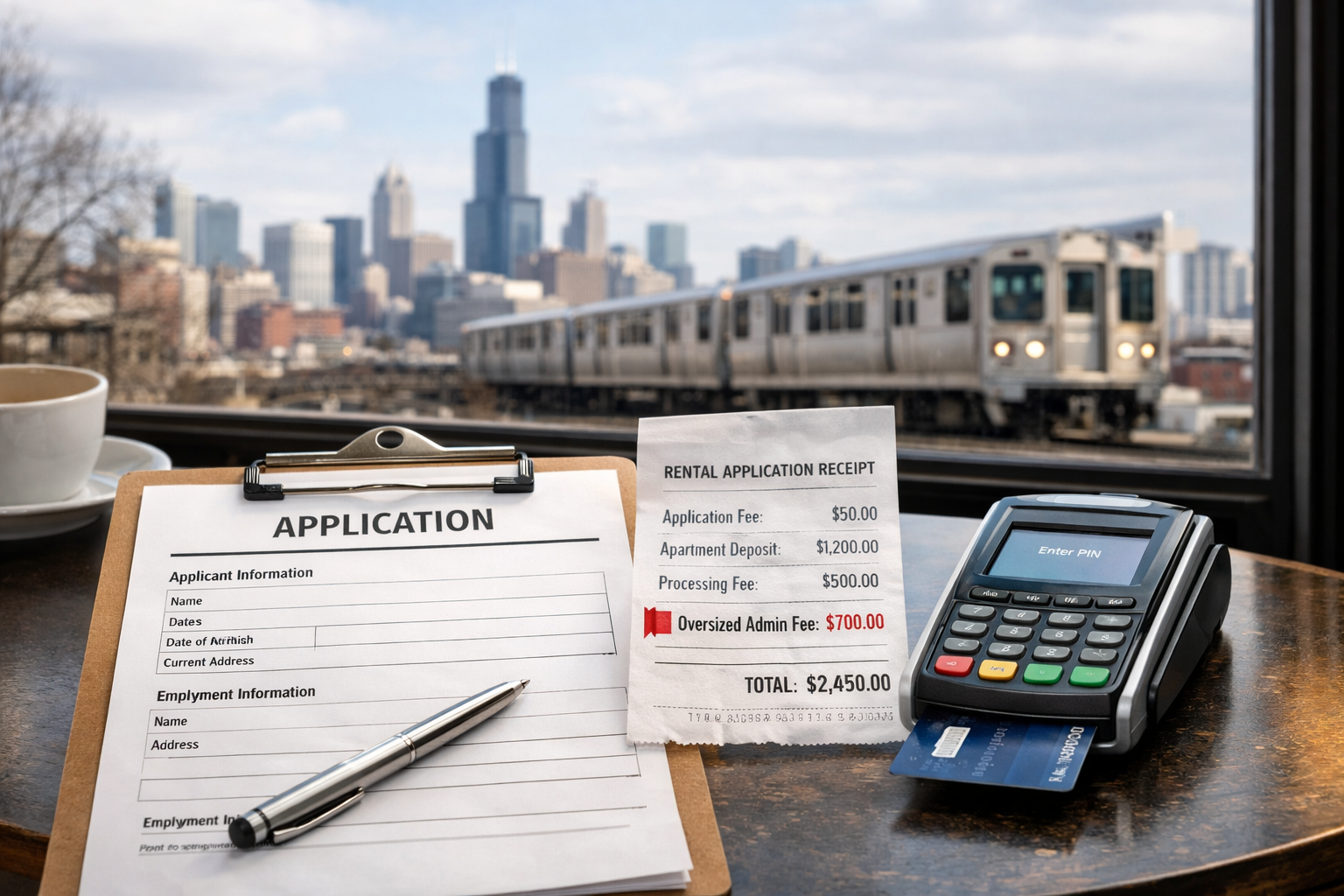
If you’ve ever applied for a Chicago apartment and felt like you were paying a cover charge just to stand in a lobby you don’t live in, you’re not imagining it. In today’s market, the Chicago rental application fee has turned a simple application into a minor financial event—especially in high-demand neighborhoods where units move faster than a seat on the Brown Line at rush hour. The key is knowing what’s standard, what’s overpriced, and what’s a flashing sign to walk away.
Why Chicago Application Fees Feel So Personal
In a perfect world, an application fee would be exactly what it sounds like: the cost of screening you (credit, background, eviction history) so a landlord can decide if you’re a good bet.
In the real Chicago world, “application fee” sometimes shows up with friends:
- “Admin fee”
- “Move-in fee”
- “Lease processing”
- “Tech package”
- “Resident onboarding”
- “One-time building fee”
- “Hold fee”
Some are legitimate. Some are just rent’s sneaky cousins.
What’s Normal in Chicago Right Now
Let’s put numbers on it—because vague fee talk is how people end up paying $300 to be told, “We went with another applicant.”
Typical application fee (per adult)
In many Chicago buildings and management companies, a common range is about $50–$75 per adult applicant.
You’ll often see this charged:
- Online (card or ACH)
- Per person, 18+
- Non-refundable (because the screening was run)
Normal-feeling signs:
- The fee is clearly labeled as screening
- They tell you what it covers (credit/background)
- You get an email receipt immediately
Typical admin fee (per apartment, not per person)
Here’s where Chicago gets spicy.
An admin fee is usually a one-time charge tied to processing the lease and holding the unit once you’re approved. In the Chicago market, it’s commonly reported in a wide range—roughly $250–$700 per apartment, with $400–$500 often showing up as the “most common” zone in managed buildings.
Important nuance: in many setups, the admin fee is non-refundable, but may be refundable if you’re declined (not if you change your mind).
What’s normal:
- Admin fee is disclosed before you apply
- It’s charged after approval (or at least clearly explained)
- It’s per unit, not multiplied by roommates
What’s not normal:
- “Admin fee” + a second “processing fee” + a “screening fee” that looks duplicated
Move-in fees: Chicago’s favorite substitution
Chicago is well-known for move-in fees instead of traditional security deposits in many buildings. Ranges vary a lot, but you’ll often see a few hundred dollars—and in some market guides, typical move-in fees are described around $425–$700.
Move-in fees usually go to the landlord/building and are typically non-refundable. A security deposit, when used, is generally refundable (assuming you don’t turn the unit into a DIY demolition site).
Condo and high-rise building fees (the “HOA plot twist”)
If you’re renting a condo (or a unit in a condo building), the building itself may charge:
- Move-in fee
- Move-out fee
- Elevator deposit (often refundable)
- Building orientation/registration fees
Real example from a live Chicago condo listing: $500 non-refundable lease fee, plus a $250 move-in fee and a $250 elevator deposit (refundable).
That’s not “normal” for every rental, but it’s normal enough in condo-land that you should budget for it.
The Rules and the Reality
I’m not your attorney, and Chicago landlords have been creatively naming fees since forever. But there are a few rules and trends worth knowing so you can ask better questions.
If you have a reusable/portable tenant screening report, ask about it
Illinois has moved toward allowing reusable (portable) tenant screening reports—and when a qualifying report is provided, housing providers may be restricted from charging an application/screening fee in that situation.
Practical takeaway:
Before you pay, ask:
- “Do you accept a reusable/portable tenant screening report?”
- “If I provide one that meets Illinois requirements, do you waive the screening fee?”
Even if the answer is “no,” the way they answer tells you a lot about how transparent they’re going to be later.
A potential fee shake-up is being debated at the state level
Illinois lawmakers have debated a “junk fee” style bill aimed at rental fee transparency and limits. One version (HB3564) has included a $50 cap on application/background check fees (with exceptions) and would take effect July 1, 2026 if enacted in that form. As of late 2025, it passed the Senate and needed House action to move forward.
Practical takeaway:
Even before laws change, pressure changes behavior. More renters are challenging fees, and more landlords are getting careful about receipts, descriptions, and disclosure.
The Red Flags: When a Fee Stops Being Normal
Here are the moments I’d label “Chicago Red Flag Behavior,” with no hesitation.
Red flag #1: The fee is wildly above market with no explanation
If you’re seeing:
- $150+ per adult for “application”
- $300 “screening”
- a pile-up of small fees that magically equals a large fee
Ask for an itemized breakdown. If they can’t explain it cleanly, treat that as your answer.
Red flag #2: You’re asked to pay before you can verify the unit exists
Classic scam pattern:
- “Lots of interest—pay the fee now to hold it.”
- No tour
- No legitimate leasing office
- No verifiable management company
- Pressure language (“today only”)
In Chicago, real demand exists—but real operations still have basics: documentation, receipts, and a clear process.
Red flag #3: Fee stacking that duplicates the same purpose
Watch for combos like:
- “Application fee” + “screening fee” + “background fee” (same thing, three times)
- “Admin fee” + “lease processing” + “move-in admin” (tell me which is which)
If a fee is legitimate, it should be easy to describe in one sentence.
Red flag #4: Cash, Zelle, gift cards, or “send it to my cousin”
Paying through informal channels is not automatically fraud, but in rental applications it’s a bright warning light—especially if they avoid providing:
- A business name
- A receipt
- A written policy
Red flag #5: “Refundable” fees with fuzzy refund rules
A lot of people hear “refundable” and stop listening. Don’t.
Ask:
- “Refundable under what conditions?”
- “What’s the timeline?”
- “Is it refundable if I’m approved but choose not to sign?”
- “Is it refundable if the unit is no longer available?”
If they can’t answer quickly, it’s not refundable. It’s “refundable in spirit.”
Real-World Chicago Scenarios (and how I’d handle them)
Scenario 1: The River North high-rise stack
You see:
- $65 application fee per adult
- $450 admin fee per apartment
How to handle:
- Ask if the admin fee is refundable if declined (get it in writing).
- Ask what the admin fee actually covers (lease prep, holding the unit, etc.).
- Confirm whether there are additional building fees later (move-in, amenity, package).
This can be normal in managed buildings—what matters is disclosure and consistency.
Scenario 2: The Logan Square “private landlord special”
You see:
- $40 application fee
- Wants pay stubs, references, and a quick decision
How to handle:
- Ask what screening service they use (basic transparency test).
- Offer a reusable/portable screening report if you have one.
- Make sure you get a receipt and the landlord’s full name/contact in writing.
Private rentals can be cheaper upfront, but only if the process is real and documented.
Scenario 3: The Streeterville condo rulebook surprise
You see:
- $75 application fee
- $300 move-in fee
- $300 move-out fee
- $250 elevator deposit
How to handle:
- Ask for the building move-in/move-out policy before applying.
- Confirm what is refundable and what is not.
- Build these into your upfront cost math before you fall in love with the view.
Condo buildings don’t care that you’re “just renting.” Their rules apply anyway.
A 10-Minute Checklist Before You Pay Any Fee
Run this like a pre-flight checklist.
- Who am I paying? (company name, portal, address)
- What does the fee cover? (screening vs admin vs building)
- Is it per person or per apartment?
- When is it charged? (before applying, after approval, at lease signing)
- Is any part refundable? Under what conditions?
- Do I get a receipt immediately?
- Have I toured (or verified) the unit?
- Are there more mandatory fees later? (move-in, utilities package, amenity, HOA fees)
If you can’t get clean answers, don’t “hope it’s fine.” In Chicago rentals, hope is expensive.
What This Means for Renters, Buyers, and People Relocating
If you’re relocating, the sticker shock often isn’t the rent—it’s the upfront pile.
Chicago’s average rent is already a serious monthly number in many areas, and fees can add hundreds more before you even get keys.
For renters: you want predictability and transparency.
For buyers who are renting while shopping: you want flexibility and minimal junk fees.
For relocators: you want speed without getting played.
And that’s the point: paying a normal fee is one thing. Paying mystery money is another.
Summary: What’s Normal vs. What’s a Red Flag
Normal (often):
- $50–$75 application fee per adult
- Admin fees disclosed upfront (often $250–$700 per apartment)
- Condo building move-in fees and refundable elevator deposits (when documented)
Red flags (always):
- Paying before you can verify the unit or the landlord
- Fee stacking with duplicated purposes
- No receipt, no explanation, pressure tactics
- Weird payment methods and vague refund promises
Best move:
- Ask clear questions.
- Get everything in writing.
- Walk away fast when answers get slippery.
Visit TourWithAgent.com to schedule curated apartment tours in Chicago with real availability, real pricing, and an expert agent to guide you.