
If you’ve toured apartments in Chicago lately, you’ve probably felt it — things move faster. Fewer paper forms. Instant pricing shifts. Approval emails that arrive before you’ve even finished your coffee. That’s AI in real estate rentals at work.
After years covering Chicago housing — from the high-rise cranes of the West Loop to courtyard walk-ups in Lakeview — I can tell you this shift isn’t cosmetic. It’s operational. And it’s changing how renters search, how agents close, and how buildings price every square foot in this city.
Let’s unpack what that really means.
The Rise of AI in Chicago’s Rental Market
Chicago is one of the most data-rich rental markets in the country. Thousands of multifamily units downtown. Seasonal leasing cycles tied to universities and corporate relocations. Wide pricing gaps between neighborhoods.
That makes it fertile ground for AI in real estate rentals.
Large property management companies now use machine learning systems to manage:
- Dynamic rent pricing
- Tour scheduling
- Lead scoring
- Tenant screening
- Renewal predictions
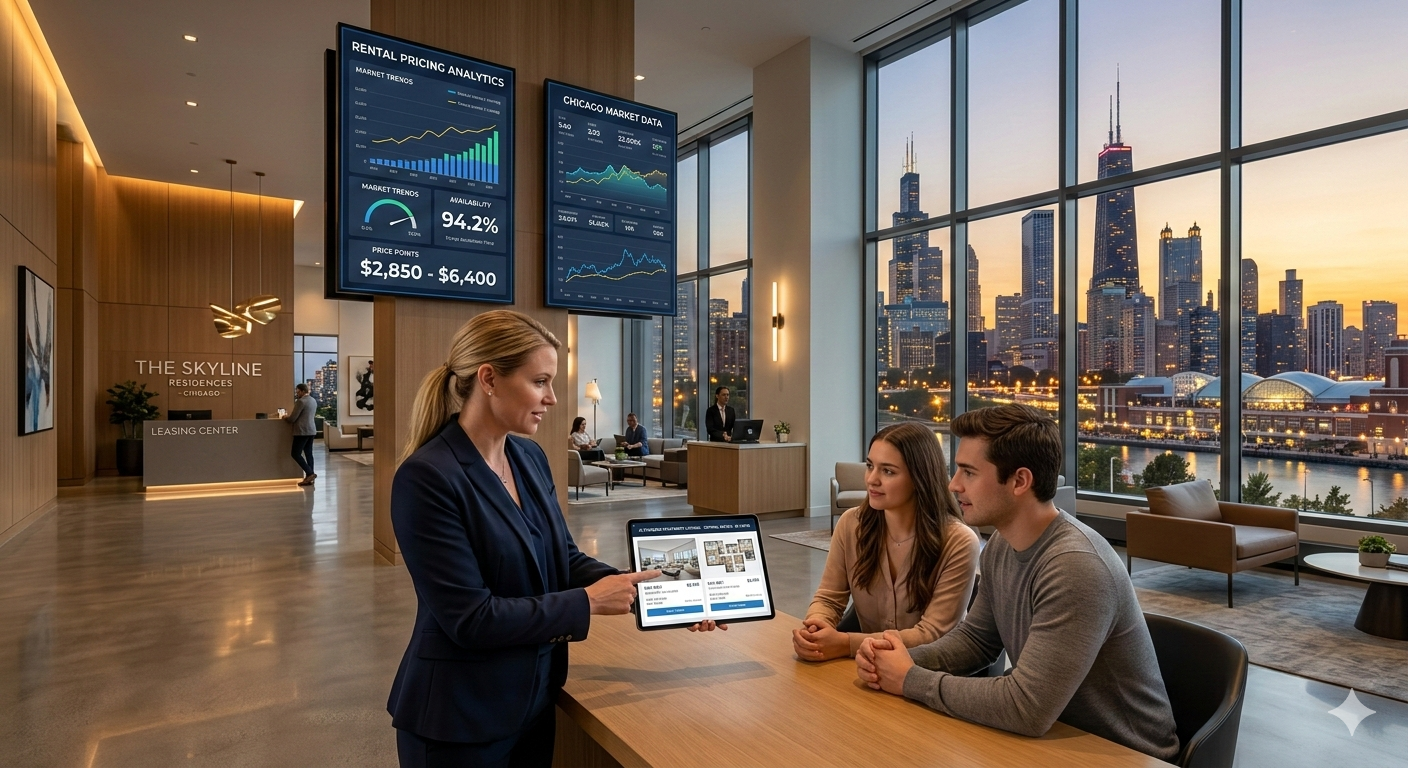
What used to be a clipboard and a leasing manager’s intuition is now predictive analytics running 24/7.
Smart Pricing: Algorithms Are Setting the Rent
From “Market Feel” to Mathematical Precision
In the past, pricing looked like this:
- Check competitor listings
- Review occupancy
- Adjust monthly
Now, algorithms monitor:
- Daily inquiry volume
- Website traffic spikes
- Competitor rent changes
- Lease expiration schedules
- Time of year
In Chicago, seasonality matters.
Real-World Example: West Loop
A one-bedroom in West Loop might price like this:
- January: $2,350
- April: $2,650
- July: $2,900
Same unit. Different demand curve.
That’s AI in real estate rentals recalibrating daily.
For renters, this means:
- Touring early in winter can save hundreds
- Waiting until peak summer often costs more
- Holding units quickly matters
It’s airline pricing, but for apartments.
AI-Powered Apartment Recommendations
Ever notice how rental platforms suddenly show listings that feel tailored?
That’s behavioral tracking at work.
AI systems analyze:
- Budget filters
- Neighborhood clicks
- Time spent viewing photos
- Amenity preferences
- Commute patterns
If you’re searching for dog-friendly units near the Blue Line, the system learns quickly.
For someone relocating to Chicago from New York or Austin, this reduces guesswork and speeds up the process.
Instead of 40 tours, you might need five.
Automated Tenant Screening: Faster Approvals
In competitive buildings in River North or Streeterville, speed wins.
Traditional process:
- Manual credit review
- Income verification by email
- 48–72 hour approval time
AI-driven screening now evaluates:
- Credit history
- Debt-to-income ratio
- Rental payment records
- Fraud risk patterns
Approvals often come within hours.
For renters, that reduces anxiety.
For landlords, it reduces vacancy days — and every vacant day in a $2,700 unit costs real money.
Virtual Tours and Remote Leasing
Remote leasing isn’t new. But AI-enhanced virtual tours now:
- Track what rooms renters focus on
- Suggest similar layouts
- Score lead intent
Professionals relocating to Chicago tech hubs like Fulton Market can:
- Tour virtually
- Apply digitally
- Get approved quickly
- Sign electronically
All before their moving truck hits I-90.
AI in real estate rentals makes long-distance renting more realistic than ever.
Chatbots and 24/7 Leasing
Many Chicago buildings now use AI chat assistants to:
- Answer availability questions
- Provide pricing
- Schedule tours
- Pre-qualify renters
Response time is often under 60 seconds.
In a city where renters browse listings late at night after work, that matters.
Leasing teams save time. Renters get immediate clarity.
Benefits for Renters
AI is delivering tangible improvements:
- Faster approvals
- Smarter apartment matches
- Clearer pricing trends
- Reduced paperwork
- Shorter leasing cycles
But here’s the Chicago columnist reality: technology doesn’t know which block gets noisy on Friday nights or which building’s elevators break twice a month.
Data is powerful. Local expertise is irreplaceable.
What It Means for Leasing Agents
Agents who embrace AI tools gain:
- Better-qualified leads
- Higher closing efficiency
- Reduced administrative tasks
- Data-backed pricing conversations
Those who resist? They fall behind.
AI in real estate rentals doesn’t eliminate agents. It filters out inefficiency.
The strongest agents combine:
- Market knowledge
- Negotiation skills
- Real-time data
- Neighborhood fluency
That combination closes deals faster.
What It Means for Buyers and Investors
Rental analytics often predict investment strength.
If AI systems show:
- Rising lease velocity
- Strong occupancy
- Seasonal rent growth
That signals demand stability.
In neighborhoods like Logan Square or South Loop, consistent rental absorption often precedes investor interest.
Rental data has become investment intelligence.
Potential Risks and Concerns
No system is perfect.
Pricing Volatility
Rents can change daily. That frustrates renters.
Algorithm Bias
Screening tools must comply with fair housing laws.
Reduced Human Interaction
Automation can feel impersonal.
The solution isn’t removing AI. It’s balancing it with real service.
Why Chicago Still Needs Human Guidance
Chicago is layered.
Pilsen is not Gold Coast. Rogers Park is not West Loop. A $1,500 budget means different realities in different ZIP codes.
AI can calculate demand curves. It can’t walk you through block-by-block differences.
That’s where guided touring still matters.
Summary: The Rental Market Is Faster Than Ever
AI in real estate rentals has transformed:
- Dynamic pricing
- Screening timelines
- Apartment matching
- Tour scheduling
- Market forecasting
For renters, that means speed and personalization.
For agents, efficiency and leverage.
For investors, sharper insight.
For Chicago, it means a rental market operating in real time.
Visit TourWithAgent.com to schedule curated apartment tours in Chicago with real availability, real pricing, and an expert agent to guide you.